
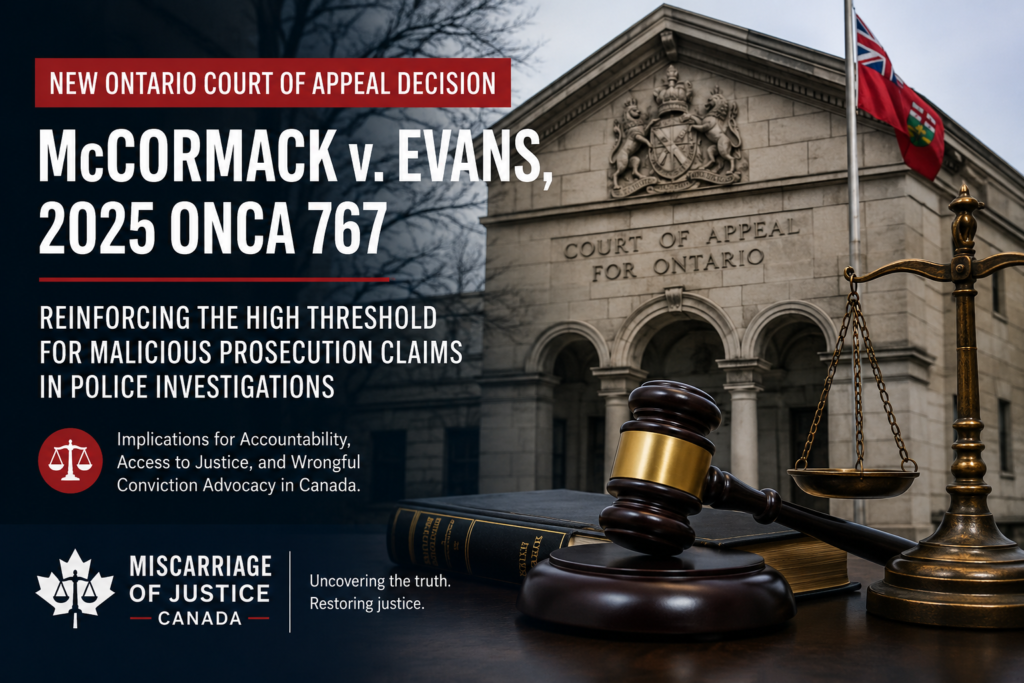
The Ontario Court of Appeal has released an important decision in McCormack v. Evans, a case that will likely have continuing significance for civil claims involving police investigations, Charter-based arguments, and allegations of malicious prosecution arising from criminal investigations.
The decision, released today, confirms the considerable evidentiary burden faced by plaintiffs seeking damages against police investigators and Crown actors following failed criminal prosecutions. The Court upheld the dismissal of a former Toronto police officer’s lawsuit against several police defendants arising from a corruption investigation involving wiretap authorizations and criminal charges.
Background of the Case
The plaintiff alleged that investigators had improperly obtained wiretap authorizations by mischaracterizing certain sources as confidential informants and argued that police lacked reasonable and probable grounds to lay charges. The lawsuit included claims for:
- Malicious prosecution
- Negligent investigation
- Misfeasance in public office
- Charter damages
At trial, the action was dismissed in its entirety. The Ontario Court of Appeal has now affirmed that dismissal.
Key Findings from the Court of Appeal
The Court concluded that:
- The intercepted communications were properly admissible;
- The alleged investigative “deception” was insufficient to invalidate the wiretap authorization;
- Police possessed both subjective and objective reasonable grounds to proceed with charges; and
- The evidentiary record did not support the serious allegations advanced against investigators and state actors.
Why This Decision Matters
This case is significant because it highlights the legal difficulty of successfully pursuing civil actions against police and prosecutors after criminal proceedings collapse or fail to result in conviction.
For wrongful conviction advocacy organizations such as Miscarriage of Justice Canada, the decision underscores several important realities:
1. The Threshold for Malicious Prosecution Remains Extremely High
Canadian courts continue to require compelling evidence of:
- absence of reasonable and probable grounds; and
- improper purpose or malice.
Even where investigative irregularities are alleged, courts remain reluctant to infer malice without clear and persuasive evidence.
2. Courts Continue to Grant Significant Deference to Police Investigations
The Court’s reasoning demonstrates ongoing judicial caution in second-guessing investigative decisions made during complex criminal investigations, particularly where wiretap authorizations and confidential sources are involved.
3. Civil Remedies Are Not a Substitute for Conviction Review Mechanisms
The decision serves as a reminder that civil litigation alone is often insufficient to address systemic wrongful conviction concerns. Structural remedies — including independent conviction review bodies such as the newly established federal Miscarriage of Justice Review Commission — remain essential to ensuring meaningful access to justice for wrongfully convicted individuals.
Broader Implications for Wrongful Conviction Advocacy
Wrongful convictions frequently arise not from a single act of misconduct, but from cumulative systemic failures involving:
- tunnel vision,
- disclosure issues,
- flawed forensic evidence,
- unreliable witnesses,
- systemic bias, and
- institutional pressures.
Cases like McCormack v. Evans illustrate how difficult it can be for individuals to obtain civil accountability after criminal proceedings have already caused devastating personal and professional harm.
For organizations advocating on behalf of potentially wrongfully convicted individuals, the decision reinforces the importance of:
- independent case review,
- evidence reinvestigation,
- access to disclosure,
- public legal education, and
- systemic reform initiatives.
As Canada moves into the new era created by the federal Miscarriage of Justice Review Commission legislation, appellate decisions of this nature will continue shaping the legal landscape surrounding accountability, investigative conduct, and access to remedies.